

Stamped parts and deep drawn parts are prone to surface scratching during the forming process. If production continues, the mold surface may also become scratched, leading to product rejection or rework. This not only increases per-unit costs but also raises mold maintenance expenses. Typically, production is halted to polish and refine the mold surface, but this can easily lead to increased clearance between the punch and die, resulting in reduced product quality.
With the increasing use of high-strength steel plates in stamping materials, molds are subjected to extremely high forming stresses, making the problem of workpiece surface scratching even more severe. As a result, the automotive mold industry faces greater challenges, and solving the issue of workpiece scratching has become a critical topic in the field.
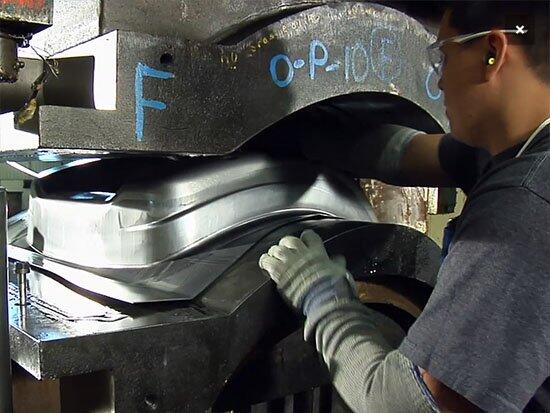 There are multiple approaches to addressing or mitigating scratching, but the fundamental principle is to alter the properties of the friction pair between the mold and the workpiece. This involves replacing the friction pair with materials that are less prone to adhesion. The core methods can be categorized into three aspects: mold structure optimization, material treatment, and process adjustments. Below are effective solutions based on the latest industry practices:
1. Mold Structure Optimization (Most Economical and Long-Lasting Solution)
-
Superfinishing and Coating Technology:
- Perform mirror polishing on the punch and die working surfaces to reduce the friction coefficient.
- Apply TD coating (vanadium carbide) or PVD coating (e.g., TiCN, CrN) to enhance surface hardness (up to HV 2200–3600) and anti-adhesion properties, especially suitable for stainless steel and high-strength steel plates.
- Advantages: Fundamentally changes the contact surface properties, prevents direct adhesion between the material and the mold, and offers long-lasting effects at a low comprehensive cost.
-
Material Upgrade:
- Use hardened alloy steel (e.g., SKD11, DC53) for punches and dies to enhance tensile resistance.
- Note: For large molds, heat treatment processes must be controlled to prevent cracking. For small-batch production, local hard alloy inserts can be used.
-
Structural Design Improvements:
- Add precise guide pins and positioning pins to avoid material misalignment and friction.
- Incorporate strong pressure surfaces (reinforcement blocks) at bending stations to pre-compress the material and reduce flow-related scratching.
2. Material and Process Adjustments (Auxiliary Measures)
-
Lubrication Management:
- Use specialized drawing oils with EP (extreme pressure) additives to form an isolation film.
- Regularly clean oil passages to ensure even lubrication (moderate-viscosity stainless steel drawing oil is recommended).
-
Surface Pretreatment (Suitable for Small Batches):
- Apply phosphating or spray coating to soft or appearance-critical parts to generate a non-metallic protective film.
- Alternative solution: Cover with PVC film (less efficient, suitable only for large single-piece production).
-
Stamping Parameter Control:
- Reduce stamping speed to minimize instantaneous friction.
- Adjust blank holder force: Too little force causes wrinkling, while too much exacerbates scratching (requires experimental optimization).
3. On-Site Maintenance and Production Management
-
Strict Mold Cleaning:
- Clean the mold cavity every 2–4 hours to remove metal debris and oil stains (a primary cause of scratching).
- Regularly inspect edge wear and perform preventive grinding to avoid defect accumulation.
-
Establish a Rapid Response Mechanism:
- Respond to scratching issues within 10 minutes of detection on the production line (e.g., adjust lubrication or air pressure).
- Record fault data to implement targeted improvements for high-frequency issues.
-
Implement TPM (Total Productive Maintenance):
- Involve operators in daily inspections to ensure uniform spring force and clear vent holes.