

In the production process of metal products, metal forming technology plays a crucial role. Among them, sheet metal processing is a common metal forming method, which covers a variety of processes such as metal deep drawing and metal stamping. Metal deep drawing is the process of stretching the sheet through the deep drawing die to form the desired shape, while metal stamping is the use of stamping dies to pressure process the sheet to achieve the molding of the product. In this process, the design of stamping die and progressive stamping die is especially critical. Especially the deep drawing mold design, its importance is self-evident, because it directly affects the product quality and production efficiency. An excellent deep drawing die design not only ensures the stability of metal forming, but also reduces the production cost and improves the competitiveness of the enterprise.
1. First deep-drawing mold
(1) First deep-drawing die without crimping device This die has a simple structure and is commonly used for deep-drawing of plates with good plasticity and relative thickness. The workpiece is positioned by positioning plate 2, and the unloading of the workpiece after deep-drawing is completed by the step at the bottom of the concave mold, and the deep-drawing cam has to go deep under the concave mold, so the mold is only suitable for shallow deep-drawing.
(2) First deep-drawing die with an elastic crimping device This is the most widely used form of first deep-drawing die structure. The crimping force is generated by the compression of the elastic element. This device can be installed in the upper die section (i.e. upper crimp) or in the lower die section (i.e. lower crimp). The upper crimp is characterized by the fact that it is not possible to use very large springs or rubbers due to the restricted spatial location of the upper die, so the crimping force of the upper crimping device is small, and this device is mainly used in applications where the crimping force is not large. On the contrary, the lower crimping device crimping force can be larger, so the deep drawing mold is often used under the crimping device.
(3) drop first deep-drawing composite mold for the first time in the general-purpose presses used in the drop oblique deep-drawing composite mold. It generally uses strips as blanks, so it is necessary to set the guide plate and unloading plate. Deep-drawing convex die 9 top surface is slightly lower than the drop concave die 10, edge surface about a material thickness, so that the drop material is completed before deep-drawing. During deep drawing, the press cushion is used to press the edges by means of the top bar 7 and the crimping ring 8. After deep-drawing, the piece is lifted by the top bar 7 and unloading is carried out by the rigid unloading plate 2.
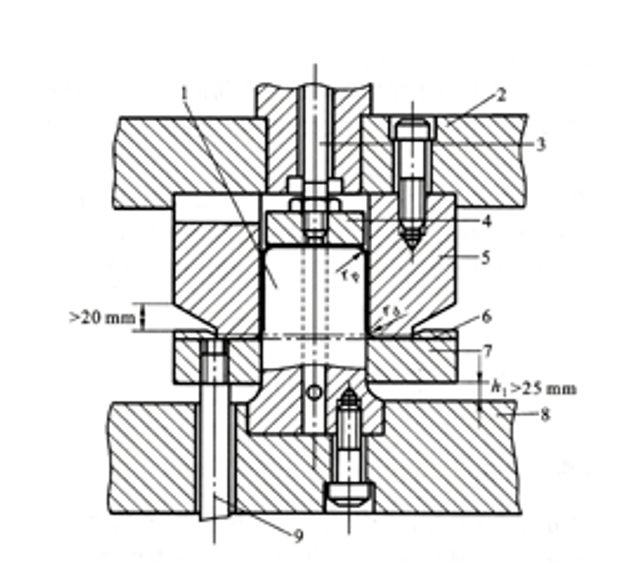
1 a convex die; 2 an upper die holder; 3 a striking rod; 4 a push piece block; 5 a concave die; 6 a positioning plate; 7 a crimping ring; 8 a die holder; 9 an unloading screw first deep drawing die with crimping device (4) First deep drawing die used on double-acting presses because of the double-acting press has two slides, the convex die 1 is connected to the deepening slider (inner slider), and the upper die holder 2 (with the crimping ring 3 on the upper die holder) to the crimping slider (outer slider), and the upper die holder 2 (with crimping ring 3 on the upper die holder) to the crimping slider (outer slider), the upper die holder 2 (with crimping ring 3) to the crimping slider (outer slider). The upper die holder 2 (the upper die holder is equipped with a crimping ring 3) is connected to the crimping slide (outer slide). When deep-drawing, the crimping slide first drives the crimping ring to press the blank, and then the deep-drawing slide drives the deep-drawing convex mold downward for deep-drawing. This mold is equipped with a rigid crimping device, so the mold structure appears to be very simple, the manufacturing cycle is also short, the cost is also low, but the press equipment investment is higher.