

In the production process of metal products, metal forming technology plays a crucial role. Among them, sheet metal fabrication is a common metal forming method, which covers a variety of processes such as deep drawing and metal stamping. Metal deep drawing is the process of stretching the sheet through the deep drawing die to form the desired shape, while metal stamping is the use of stamping dies to pressure process the sheet to achieve the molding of the product. In this process, the design of stamping die and progressive stamping die is especially critical. Especially the deep drawing mold design, its importance is self-evident, because it directly affects the product quality and production efficiency. An excellent deep drawing die design not only ensures the stability of metal forming, but also reduces the production cost and improves the competitiveness of the enterprise.
2. Subsequent deep-drawing molds
The blanks used for subsequent deep-drawing are semi-finished cylindrical parts that have been deep-drawn for the first time and are no longer flat blanks. Therefore, its positioning device, crimping device and the first deep-drawing die is completely different. There are three common methods of positioning the deep-drawing die for subsequent processes: the first uses a specific positioning plate (Fig. 4.6.5); the second is a concave die with a concave recess for positioning the semi-finished product; and the third is to use the inner hole of the semi-finished product to position it by using the shape of the convex die or the shape of the crimping ring (Fig. 4.6.6). At this point, the crimping device used is no longer a flat plate structure, but a cylindrical structure.
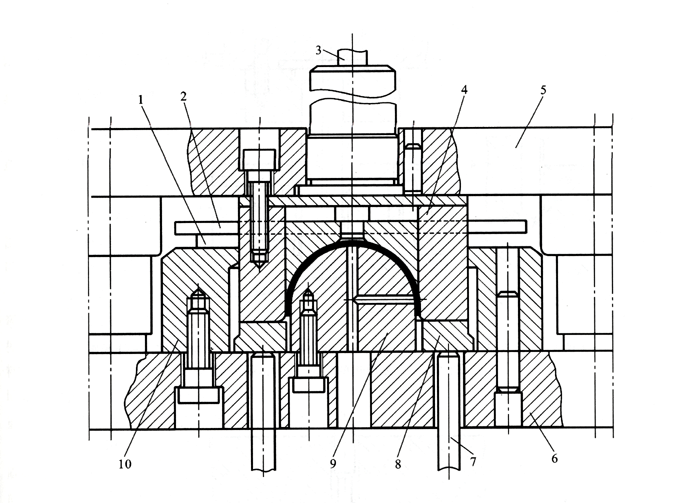
1-guide plate; 2-unloading plate; 3-beating rod; 4-convex and concave die; 5-upper die holder; 6-lower die holder; 7-rocker; 8-crimping ring; 9-deep-drawing convex die; 10-drop concave die Fig. 4.6.3 Drop deep-drawing composite die
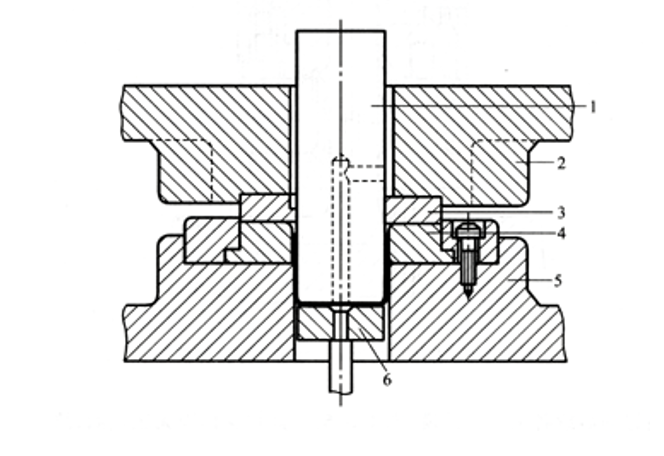
1 - Convex die; 2 - Upper die holder; 3 - Crimp ring; 4 - Concave die; 5 - Upper die holder; 6 - Ejector block Fig. 4.6.4 First deep-drawing die used on double-action presses
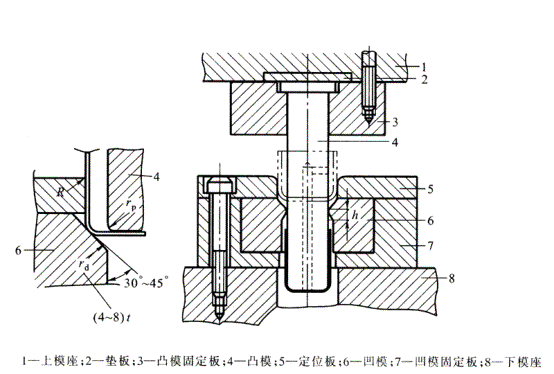
Figure 4.6.5 Deep-drawing die for subsequent processes without crimping device
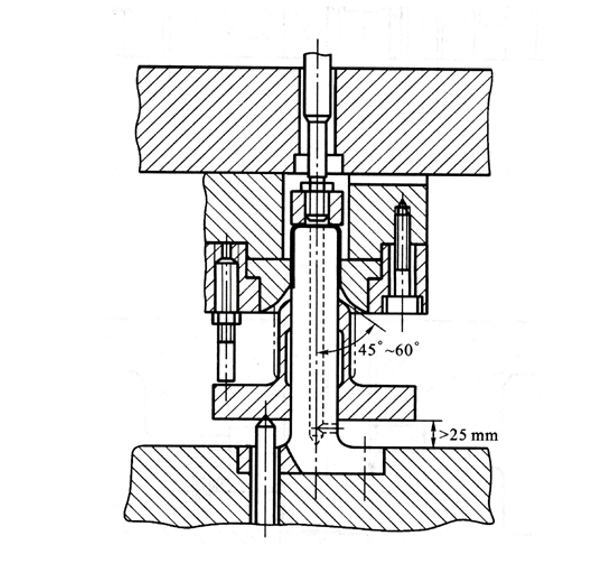
Fig. 4.6.6 Deep-drawing die for subsequent processes with crimping device (1) Deep-drawing die for subsequent processes without crimping device (Fig. 4.6.5) This deep-drawing die is not capable of strict multi-drawing due to the absence of crimping ring, and is used for deep-drawing or shaping with less diameter reduction, etc. It is used when the thickness of the sidewalls is required to be the same, or when a high degree of dimensional accuracy is required. (2) With the press device of the subsequent processes deep-drawing mold this structure is widely used form. The crimping ring also serves as a locating ring for the blank. Since the workpieces are generally deeper when they are deepened again, in order to prevent the elastic crimping force from increasing as the stroke increases, a limit pin can be fitted to the crimping ring to control the increase in crimping force.