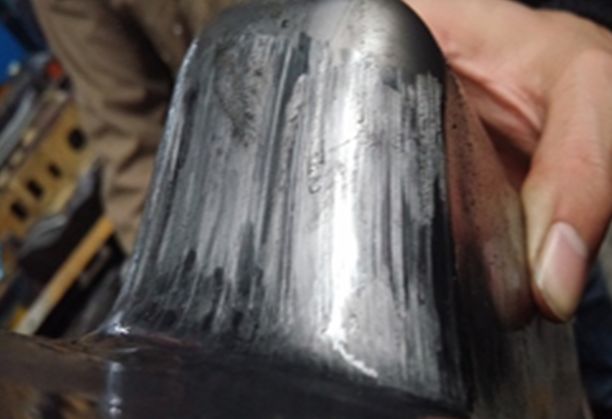
The essence of hair pulling is due to the surface of the workpiece and die local adhesion (bite), improve hair pulling problem has a variety of methods, the basic principle is to change the nature of the friction between the die and the processed parts, so that the friction vice by the material that is not easy to adhesion instead. Mould into the production site commissioning stage, to improve the hair pulling problem generally have the following methods: 1, change the mold material, increase the hardness of the mold; 2, the mold surface treatment, such as hard chrome plating, PVD and TD, etc.; 3, the mold cavity coated with nano-coating, such as the RNT technology, etc.; 4, between the mold and the processed parts plus a layer of other substances, so that the processed parts and mold separation (such as lubrication or coated with special lubricants or add a layer of PVC). Special lubricants or add a layer of PVC and other materials); 5, the use of self-lubricating coated steel.
Stamping part strain is a common quality defect in the production process, which is prevalent in major automobile production plants. On the one hand, it reduces the stability and productivity of the production process and increases the scrap rate of parts, and on the other hand, it causes more serious wear and tear on the molds, reduces the life of the molds and the accuracy of the stamped parts, and increases the number of mold repairs and production downtime.
The essence of hair pulling is due to the surface of the workpiece and die local adhesion (bite), improve hair pulling problem has a variety of methods, the basic principle is to change the nature of the friction between the die and the processed parts, so that the friction vice by the material that is not easy to adhesion instead. Mold into the production site commissioning stage, to improve the hair pulling problem generally have the following methods:
1, change the mold material, increase the hardness of the mold;
2, the mold surface treatment, such as hard chrome plating, PVD and TD;
3, the mold cavity coated with nano-coating, such as RNT technology;
4, between the mold and the processed parts plus a layer of other substances, so that the processed parts and mold separation (such as coating lubrication or special lubricants or add a layer of PVC and other materials);
5, the use of self-lubricating coated steel plate.
Mold materials, mold steel SKD11, CR12MOV, etc. is recognized as wear-resistant anti-seize materials, heat treatment hardness can reach the chromium hardness HRC58-63 degrees or so, in the mold is not large and the shape of the part is relatively simple can be used in this type of material, but the material is difficult to heat-treat the processing of the material, brittle, easy to crack, the cost is high, the size of the limitations, and This kind of material is deformed after heat treatment, and the research and matching work after heat treatment is huge.
Automotive plate shape is more complex and more and more use of high-strength steel plate, such parts of the overall performance requirements of the mold is higher, which are usually used in the mosaic structure, mosaic surface treatment process currently have TD, hard chrome plating, nitriding, PVD and so on.
TD treatment is the thermal diffusion method of carbide cladding treatment (Thermal Diffision Carbide Coating Process) for short, the technology was first developed by the Toyota Central Research Institute in Japan in the seventies and applied for a patent, also known as the Toyota Diffusion Process, referred to as the TD Process, that is, TD processing. TD Process. It is also called Molten Salt Diffusion Process, or TD Process for short. Regardless of its name, the principle is to place the workpiece in the molten borax mixture, through high temperature diffusion on the surface of the workpiece to form a metal carbide cladding.
TD cladding treatment of the main features are: high hardness of the cladding, HV up to 3000 or so, with a high degree of wear resistance, tensile strength, corrosion resistance and other properties, TD cladding service life of about 100,000 units; but TD cladding treatment of the mold material is very high, and belongs to the high-temperature treatment of the thermal stresses produced during the thermal stress, phase stress, changes in the specific volume of the mold will make the mold is easy to produce deformation or even cracking in the heat treatment process. General repair of the mold in the weld will also appear cracking phenomenon, TD cladding treatment of mold processing quality and shape has high requirements; In addition, TD cladding treatment after reprocessing difficulties, unable to meet the needs of design changes and adjust the mold mold repair needs, has done other surface treatment of the mold, the need to be completely removed from the original surface treatment, otherwise it will affect the quality of the surface of the TD cladding. In addition, TD cladding treatment technology will generally be treated 3-4 times after the service life of the phenomenon will be reduced.
Stamping part strain is a common quality defect in the production process, which is prevalent in major automobile production plants. On the one hand, it reduces the stability and productivity of the production process and increases the scrap rate of parts, and on the other hand, it causes more serious wear and tear on the molds, reduces the life of the molds and the accuracy of the stamped parts, and increases the number of mold repairs and production downtime.
PVD (Physical Vapor Deposition) that is, physical vapor deposition method, PVD coating is the use of physical vapor deposition method of surface coating. It has good performance of anti-tensile, the hardness of the coating can be as high as HV2000-3000, or even higher, so it has excellent wear-resistant performance, and its processing temperature is relatively low, the deformation of the processing workpiece is small, and it can be processed for many times without affecting the life of the advantages of the plating and the substrate, but the combination of its plating and the substrate is relatively poor, and it is easy to make the plating fall off and not play its anti-tensile, and it can not play its anti-tensile, and it can not play its anti-tensile. However, the bonding between the coating and the substrate is poor, and it is easy for the coating to fall off when used on deep-drawing dies and dies with high molding pressure, thus failing to exert its effect of tensile and wear resistance.
Figure 3 PVD coating
The size of the outer plate mold is generally larger, such as the use of mosaic block structure, the splices will be strained, so most of the whole structure, the material is generally used ductile cast iron and other cast iron materials. The hardness of the molding part can reach HRC50-55 degree after quenching by flame. Integral structure of the outer plate mold surface treatment is mostly used hard chrome plating process, but its surface hardening effect is limited, the surface hardness of about 1000HV or so, in addition, hard chrome plating of the plating and mold base material is a mechanical combination, in the molding of larger pressure is easy to fall off, the plating layer is off once the tensile strength will be lost. When the hardened surface layer is worn out, pulling hairs will appear again, and the life of the hardened surface layer is generally about 5-10 million units.
Figure 4 Chrome plating
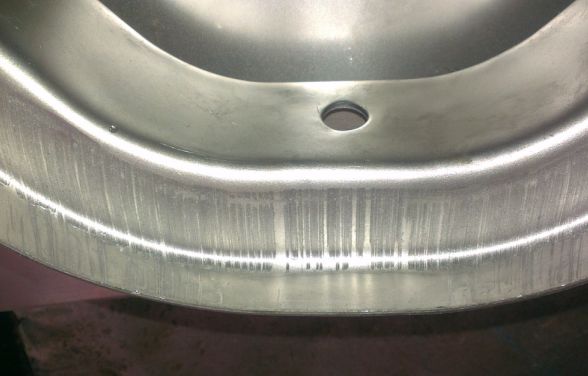
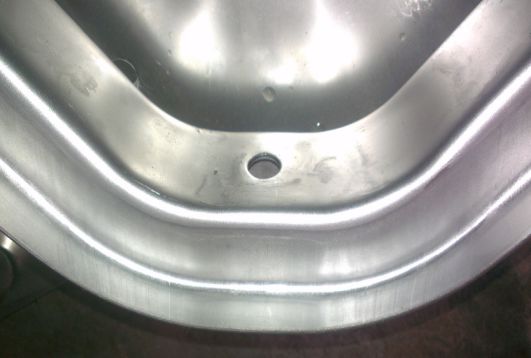
RNT is an emerging technology in recent years. Its working principle is the RNT coating liquid on the mold cavity coating, through the pressure to make the coating nanomolecules diffuse and act on the surface of the mold to form a nano-metal carbide cladding, the process of expansion from the inside out, the thickness and hardness of the mold with the increase in the working time and increase the thickness of the coating in the 0.1-1 μm, the hardness of the coating in the HV1100 The thickness of the coating is 0.1-1μm, the hardness of the coating is HV1100-1600, even when the mold is subjected to a large load, it will not cause the coating layer on the surface to fall off and fail due to the plastic deformation of the substrate, the thickness and hardness of the layer increase from the inside to the outside with the increase of the working time of the mold and the number of times it is coated. The thickness and hardness of the coating layer increases with the working time of the mold and the number of times it is coated. However, the application of this technology to parts with serious hair pulling, parts with production process heat and ultra-high-strength plates is still immature and the cost of using it is high.
Figure 5 before the use of RNT pulling hair Figure 6 after the use of RNT pulling hair situation
The use of reasonable lubricants in the production process can effectively improve the friction conditions, reduce the hair pulling, its main role is to use the lubricant film to make contact with the vice-isolated, oiling is generally used by manual oiling or automated equipment at the head of the line oiling. In addition, the use of lubricants can also effectively reduce the dark wound, cracking problems. But the use of lubricants will make the environment dirty slippery, in order to improve the impact of oil on the operating environment, in recent years, Baosteel, Wuhan Iron and Steel, Maanshan Steel and other iron and steel enterprises have developed a self-lubricating steel plate, the use of self-lubricating coating steel plate has excellent self-lubricating, corrosion resistance, fingerprint resistance, processing and molding and coating properties, which is mainly rolled on the steel plate coated with a layer of organic coatings, in the stamping and molding process does not need to be coated again with lubricating oil. But the cost is a little high, has not been widely used. Due to the molding load and the molding material varies greatly, the use of what or several measures to solve the problem of workpiece strain, in addition to consider the effectiveness of the effect, but also must consider the batch size of the product, the realization of the degree of difficulty and its economy and other aspects of the problem, and then finally choose the most appropriate method.