

The traditional aerospace sheet metal manufacturing process is mostly manually operated, with a slow construction cycle, low production accuracy and uneven quality. With higher and higher requirements on aircraft performance, the shapes of sheet metal parts are becoming more and more complex, and many of them are non-linear complex surfaces, which require higher and higher surface quality and dimensional accuracy of sheet metal parts. Thanks to the application of advanced automation technology and intelligent manufacturing systems, aviation manufacturing has begun to realize the enhancement of technological processes. Hydraulic forming of metal slabs employs liquids instead of molds or uses liquid-assisted forming to reduce the processing cost of molds, shorten the production cycle, and achieve the effect of multi-purpose use of one mold.
Principle and characteristics of metal slab hydroforming
The technology is to use a metal slab hydraulic forming method, specifically the use of liquid oil instead of a rigid concave mold, so that the slab in the liquid oil pressure under the action of the convex mold fit forming, is a flexible forming technology. This kind of sheet metal hydraulic deep drawing forming universal mold mainly includes the upper mold part and the lower mold part, of which the two types are shown in Figure 1.
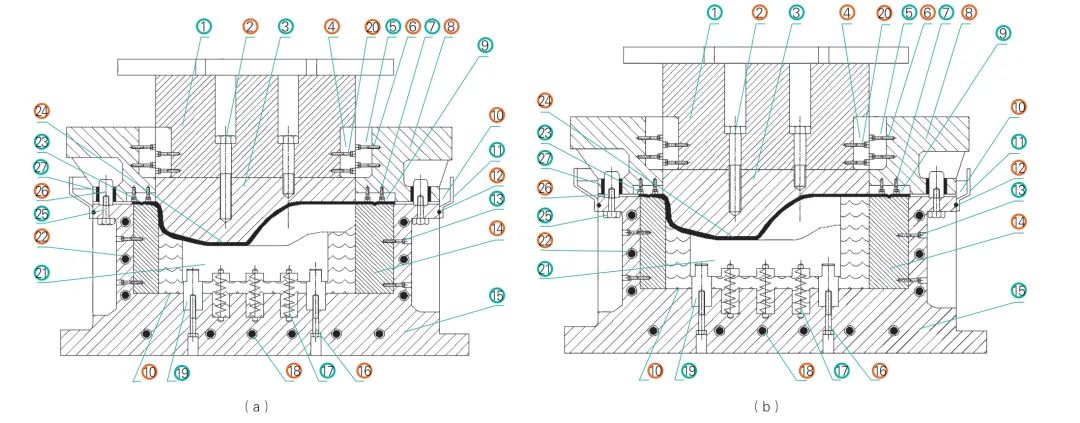
Specifically, the method is to fill the concave mold with liquid, and when the convex mold is lowered, the liquid in the hydraulic chamber of the concave mold is compressed, generating a relative pressure, which adheres the blank tightly to the convex mold, forming a powerful friction-keeping effect, so that the workpieces are formed exactly according to the shape of the convex mold. In addition, fluid lubrication is generated between the concave die and the lower surface of the sheet, which reduces harmful frictional resistance. This not only makes the forming limit of the sheet much higher, but also reduces local defects that may be generated during conventional deep drawing, thus forming parts with high precision and good surface quality. The presence of liquid oil makes sheet metal hydroforming characterized by friction holding and overflow lubrication.
Specific implementation process
The specific operation process of the deep drawing and forming mold mounted on the double-action press is as follows:
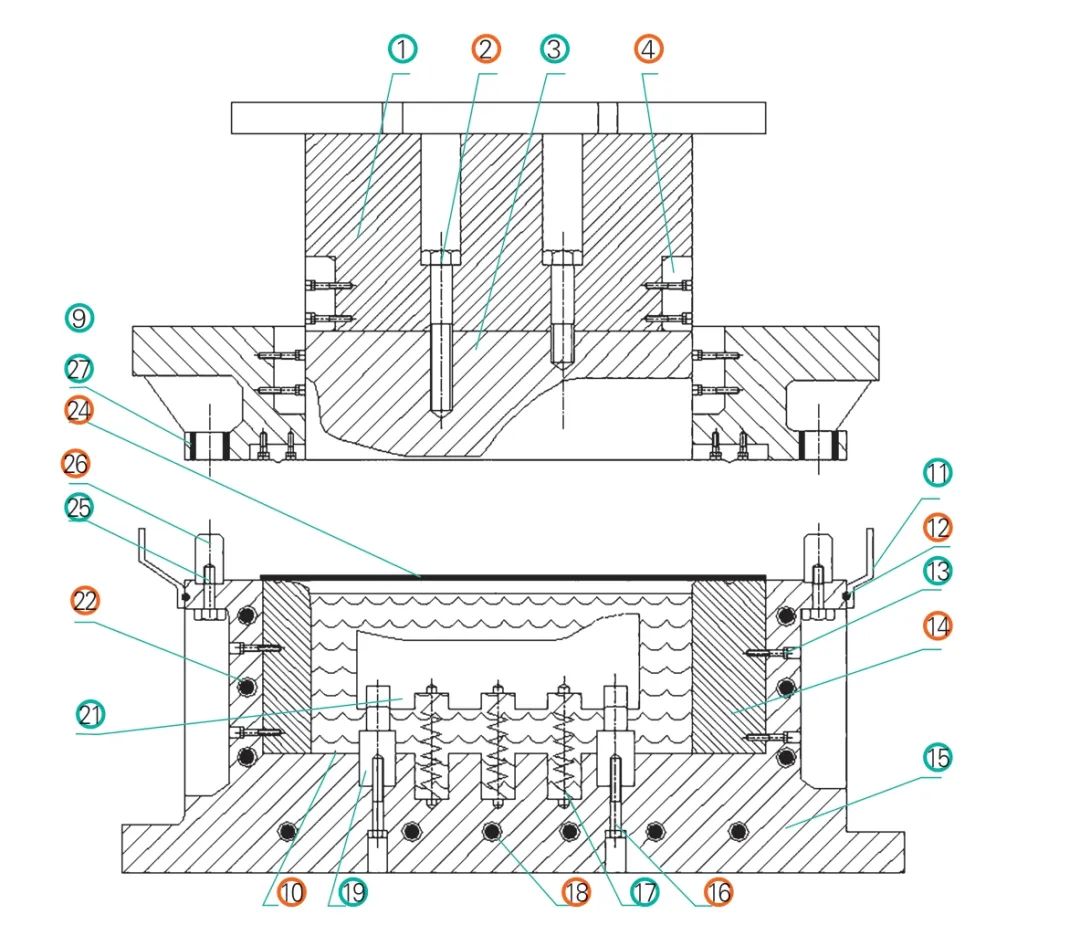
Step one. As shown in Figure 2, the upper and lower molds of the die are in the open state. First of all, the robot will have been surface lubrication oil coated slab into the lower die on the plane, and then connected with the press outside the slide on the upper die pressing edge ring in the press outside the slide driven down, pressing edge ring in the guide column, guide sleeve guiding role, fell on the upper surface of the slab, while using the deep drawing rib will be compacted, the inner slide, the outer slide plate on the upper die, the lower die to play a role in guiding. Note that the guiding stroke design is not less than 50mm.
Subsequently, under the drive of the press slider, the upper mold connected to the press slider downward, under the dual role of the convex mold core and hydraulic oil, with the gradual forming of the slab deepening and deepening, here to strictly control the downward speed of the upper mold, to prevent the overflow of hydraulic oil groove plate. Finally, the slide in the press just reached the lower stop, the bottom surface of the slab finally contact the top block on the surface of the oil film, spring compression, limit guide column is a mechanical limit, which plays a role in limiting the top block to prevent the workpiece over the limit was crushed, the top of the block at the bottom of the holes can be inserted into the upper end of the stepped limit guide column, the formation of the guide column guide sleeve to play a guiding role. Finally complete the slab deep drawing and forming process.
The second step. After the deep drawing and forming is completed, driven by the inner slide of the press, the convex mold core of the upper mold upward demolding. At the same time, driven by the outer slide of the press, the crimping ring of the upper die is lifted upward. As shown in Figure 3, under the action of spring pressure, the slab is lifted up, and then the robot grabs the slab and completes a deep-drawing and forming cycle.
Precautions for mold adjustment
Understand the specific structure of the mold
Understand the design intent of the designers, carefully understand the engineering plan, the stamping process steps, the specific structure of the mold, the installation of the sequence and so on.
Check the specific installation conditions of the mold.
(1) Check whether the pressure, crimping force, ejector force and other forming elements that the mold can carry are compatible with the press, and check whether the closing height and size of the mold are compatible with the press.
(2) Check whether the mounting associated dimensions of the mold are consistent with the press.
(3) Check whether the bolts and pressure plates for mold installation are available and meet the requirements or not.
(4) Check whether the upper and lower molds need to be installed pads and the required objects are ready.
Mold installation
To adjust and install the mold on the press of the model set in the process drawing.
Mold Adjustment
To check the test mold according to the requirements of the engineering plan, check whether each working part of the mold meets the requirements of stamping performance, and take measures to eliminate the existing problems until qualified parts can be stamped out.
Trial punching
A number of pieces are punched out in order to obtain the final results of the mold test for specific suitability.
Advantages of molds
This is a deep-drawing and forming die set on a double-action press, and has the following advantages:
(1) The forming limit is improved, and the number of times the workpiece is formed as well as the number and cost of supporting dies are reduced.
(2) The resilience of the formed parts is small, the generation of internal wrinkles is suppressed, and the surface quality and dimensional accuracy of the workpiece are improved.
(3) Mold structure is simple, processing accuracy requirements are low, good versatility, supporting the number of small, very suitable for modern small batch, multi-species flexible processing requirements.
(4) due to the application of liquid, can be formed at room temperature some difficult to form materials, such as aluminum alloys, magnesium alloys, titanium alloys, high-temperature alloys and complex structural welding plate, etc., can be processed in the shape of complex parts.
(5) Forming such parts can be used to liquid-filled deep drawing combined with local key features of the rigid die shaping method, which not only gives full play to the advantages of liquid-filled forming billet deformation uniformity and good forming performance, but also gives full play to the advantages of rigid die forming local small features, which can realize the sequential and accurate forming of complex features.
(6) Special plates require high surface quality. Due to the soft aluminum alloy, the traditional stamping process can easily cause scratches, wrinkles, slip lines and other defects on the surface of the part, and the subsequent process must be used to eliminate scratches by adding a special process. Liquid-filled forming uses high-pressure fluid media instead of rigid molds, reducing the friction between the material surface and rigid molds.
(7) The concave die and the working edge part of the crimping ring are used as inserts to improve the life of the mold.
(8) The crimping ring and the convex mold are guided between the inner slide and the outer slide, and the mold with this structure has a simple structure, easy processing and good guiding effect.
(9) In the parts where the material is easy to flow, generally are arranged with deep-drawing rib to control the material to flow evenly into the concave mold.