

Today's automated production processes require that the surface of the sheet has the desired quality of being flat and smooth. In reality, however, plates are usually deformed to varying degrees after processing. This article focuses on some common plate flatness defects and effective ways to eliminate them.
The most common defect that occurs after the material leaves the mill is coil warpage. Although coils are easy to transport in bulk, the resulting warpage can seriously interfere with subsequent processing, and subsequent precision machining is not possible due to the poor flatness of the material.
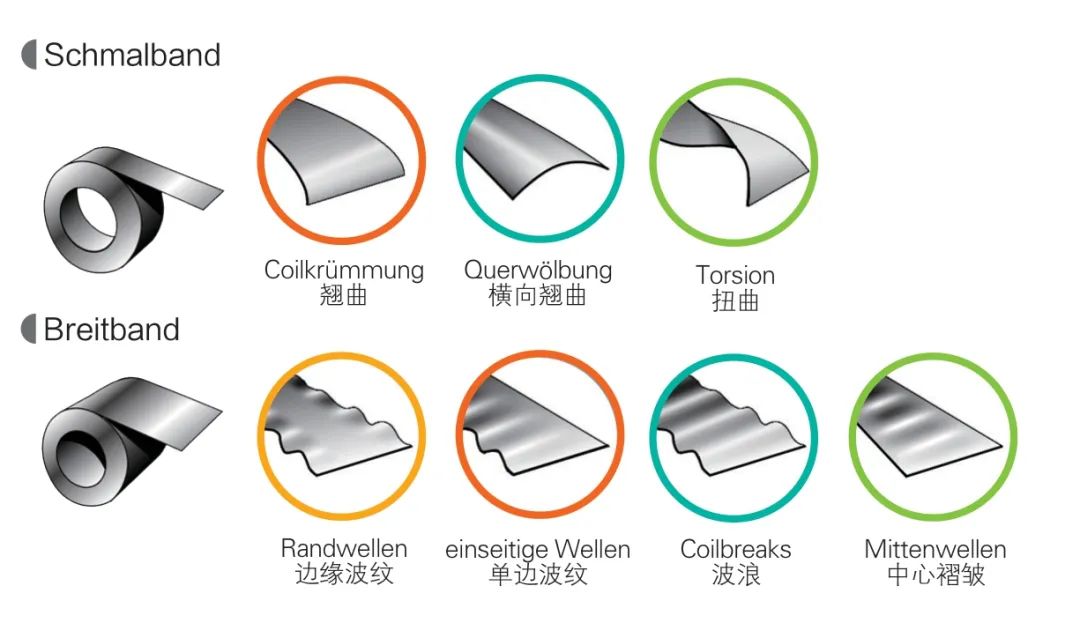
Coil warpage is common but must be dealt with
Coil warpage is the longitudinal bending of the sheet after winding. This defect is very common in coils, but other defects may also occur such as: narrower coils may have transverse warpage, i.e. bending perpendicular to the direction of winding; or torsion, i.e. twisting.
Some other flatness defects can also occur in wider coils and are common: waviness (wave bending across the entire coil), edge rippling, unilateral rippling and center folds.
In addition to defects inherent in the raw material, mechanical or thermal effects can cause stresses in the web. However, these usually occur in blanks or sheet metal parts, and the cause of these problems is the cutting process performed on the sheet metal parts.
Cutting processes can also cause defects in sheet metal parts
In order to make a product out of sheet metal, it must be cut. However, the cutting process has a significant impact on the material, and processors need to give careful consideration to their choice. It is well known that common thermal processes such as laser cutting, plasma or flame cutting generate a large amount of heat when the cutting beam touches the material, which creates a large temperature gradient in the material, resulting in stresses and edge hardening. Mechanical processes such as shearing or punching can also cause stresses in the sheet.
Defects as well as internal stresses in the sheet affect its processing. This is because a defective plate cannot produce a flatness that meets the tolerances required during the machining process. Some experienced craftsmen may know how to use the available material wisely and minimize losses, however, this method is not suitable for automated production where the process is fast and tends to produce a lot of scrap.
Leveling removes defects and residual stresses
Both winding defects and residual stresses in the sheet can be eliminated by leveling. Leveling machines (Fig. 2) level sheet metal parts with the help of leveling rollers, thus eliminating defects and stresses in the material. There are two general types of leveling equipment: coil levelers for leveling coils and part levelers for leveling individual parts or slabs. The coil levelers have a wide range of processing capabilities and are equipped with adjustable leveling rollers to effectively eliminate defects in coils.
Leveling has a positive and far-reaching effect on subsequent processes: if residual stresses and defects in the sheet metal are effectively eliminated, subsequent processes, whether bending, milling, or welding and assembly, can be carried out more accurately and efficiently, and time-consuming and laborious reworking can be avoided.