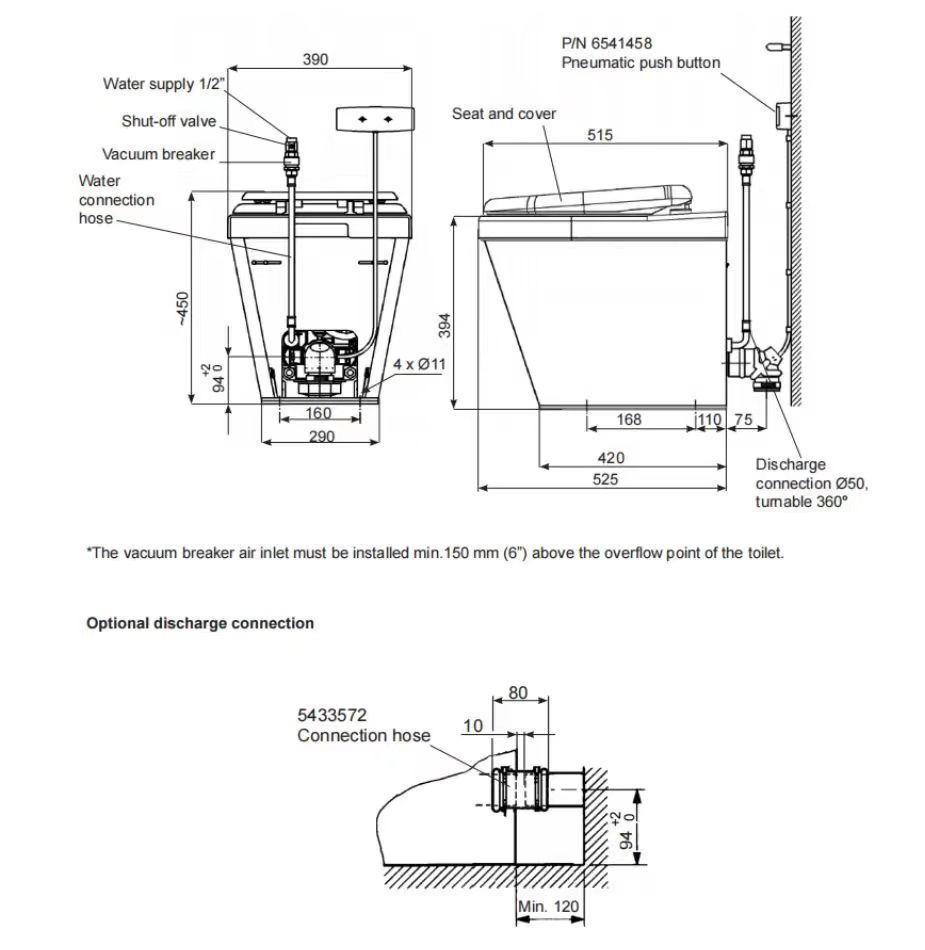
Vacuum toilet, as a kind of highly efficient water-saving sanitary equipment, utilizes advanced vacuum negative pressure technology, which requires only a very small amount of flushing water to realize powerful sewage disposal, significantly reducing the size of sewage pipes inside the building and the construction cost, while ensuring a comfortable experience of low noise and no odor in the process of using. Adopting the most common metal forming sheet metal fabrication technology- deep drawing, one-piece molding process makes the tater conservation and environmental protection and intelligent sanitation technology, widely used in all kinds of high-end buildings, transportation and public facilities, leading the sanitary ware industry to a more efficient and environmentally friendly direction of development. It is the perfect combination of modern water-saving and environmental protection and intelligent sanitation technology.
The working principle of vacuum toilet is mainly based on the negative air pressure (vacuum) technology, the core of which is to extract and transport waste by creating an environment below atmospheric pressure. The following are the detailed steps of how a vacuum toilet works:
1. Initiate Flush: When the user finishes using and activates the flush button, a valve inside the toilet opens, allowing a small amount of water (usually only 1-2 liters, much less than the 6-12 liters of a conventional toilet) to flow into the bowl, moistening the waste and making it easier to break down and transport.
2. Creating a vacuum: At the same time, a vacuum pump behind the toilet bowl starts working, extracting air from the bowl and creating a low-pressure area. This low-pressure area is known as the “vacuum.
3. Waste transportation: Under the action of the vacuum pump, the waste and flushing water inside the toilet are sucked into the vacuum pipe connected to the toilet. Since the piping is at low pressure, the atmospheric pressure outside pushes the waste and flushing water along the piping.
4. Separation: Waste and flush water are transported in the piping to a separator. In the separator, solid waste and liquid waste are separated. The solid waste usually falls into the solids collection tank of the separator, while the liquids are pumped to the wastewater treatment system.
5. Treatment and Discharge: Solid wastes need to be periodically cleaned out of the collection bins and sent to a suitable disposal site. Liquid wastes are then treated through the sewage treatment system and eventually discharged into the environment after meeting discharge standards.
Advantages of vacuum toilets include:
- Water saving: vacuum toilets are very water efficient due to the minimal amount of water used for flushing.
- Reduced pipe size: Since the waste is extracted using a vacuum, smaller diameter pipes can be used, reducing construction costs.
- Low noise: Vacuum toilets are quieter when extracting waste.
- No odor: Since there is negative pressure in the pipe, odors are not easily dispersed.
Vacuum toilets are widely used in ships, high-speed trains, airplanes, and some modern buildings, especially where water resources are tight or where there is a need to reduce the burden of sewage disposal.