

Metal stamping production process, production stability is the main problem affecting production efficiency and production costs. This paper describes in detail the main causes of production instability in the formation of hair pulling, cracking, wrinkling principle, and four kinds of measures to solve the problem. Finally, through the practical application of the measures to prove effective, for the subsequent rectification of similar projects to provide effective reference program. With the rapid development of the automobile industry in the past 10 years, the quality of automobiles is getting higher and higher, but the price is getting lower and lower, so reducing the production cost of automobiles is an urgent problem for every automobile company, and one of the most important initiatives to reduce the cost for the stamping profession is to ensure the production stability. The main reasons affecting production stability include wrinkles, cracks and hair pulling of stamped parts. Measures to solve these defects are mainly for the surface treatment of the stamping dies, mold surface treatment can reduce the surface roughness of the mold, improve the hardness, increase wear resistance. This will improve production stability and reduce production costs.
Production instability factors
Stretching
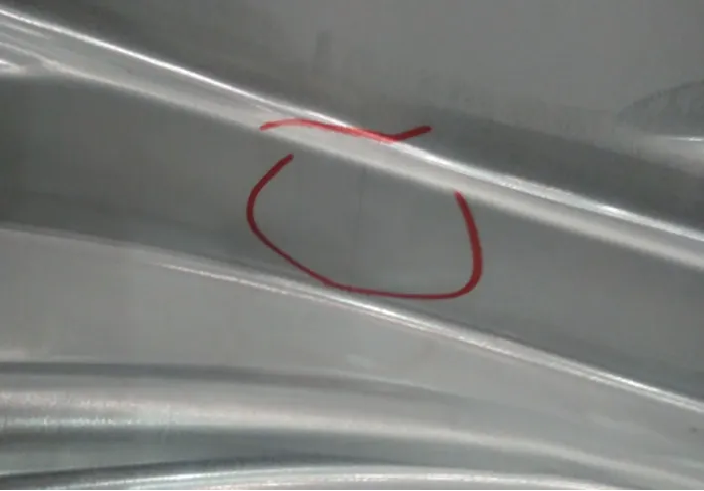
During the forming process, when the sheet and the mold slide relative to each other, adhesive wear occurs due to the forced contact between the sheet and the mold, resulting in leaving stripes on the sheet.
The occurrence of hair pulling after a period of mass production is generally caused by three reasons:
(1) The hardness of the rounded corners of the stretching concave mold decreases and is close to the hardness of the sheet, resulting in adhesion between the mold and the sheet.
(2) mold or plate material is dirty, between the mold and plate material with hard foreign objects, in the relative sliding process, scratching the mold and plate material.
(3) The concave mold corner is broken or the cracks or air holes remain after welding, and the sheet is scratched when flowing through the concave mold corner.
Cracking
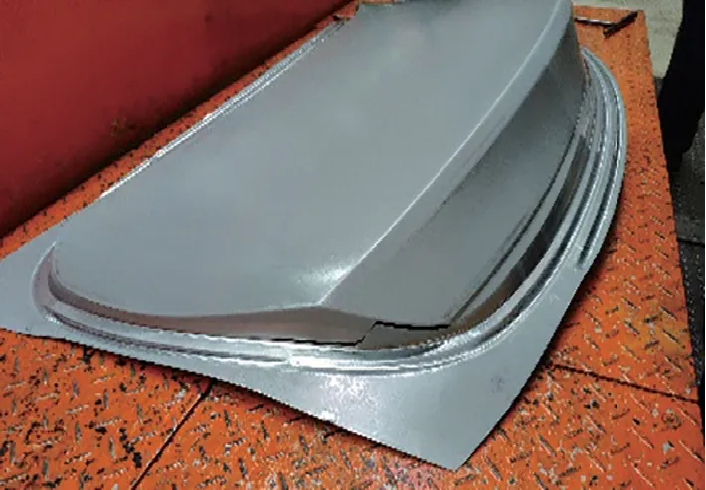
Generally speaking, cracking can be divided into strength cracking, plastic cracking, see Figure 2. strength cracking, also known as α cracking, refers to the process of stamping, the strength of the plate force transfer zone can not meet the requirements of the deformation zone deformation force required in the deformation zone, cracking in the deformation zone. For example, the cracking produced at the round corner of the convex die during deep-drawing forming of cylindrical parts belongs to strength cracking. Plastic cracking, also known as β cracking, refers to the cracking in the deformation zone in the stamping and forming process, when the deformation capacity of the deformation zone of the sheet is smaller than the deformation degree required for forming, the cracking in the deformation zone. Such as the door plate parts, stretching rib for the locking rib, the material basically does not flow, the parts through the expansion of the shape, this state of cracking belongs to the plastic cracking). According to the state of force to points, there are two types of cracking, one is subjected to X and Y two directions of tensile stress caused by cracking, usually transverse cracking; the other is the X and Y two directions of a tensile stress, the other is the compressive stress, the relative movement of neighboring metal lattice is too large to produce the cracking, generally longitudinal cracking.
Wrinkle
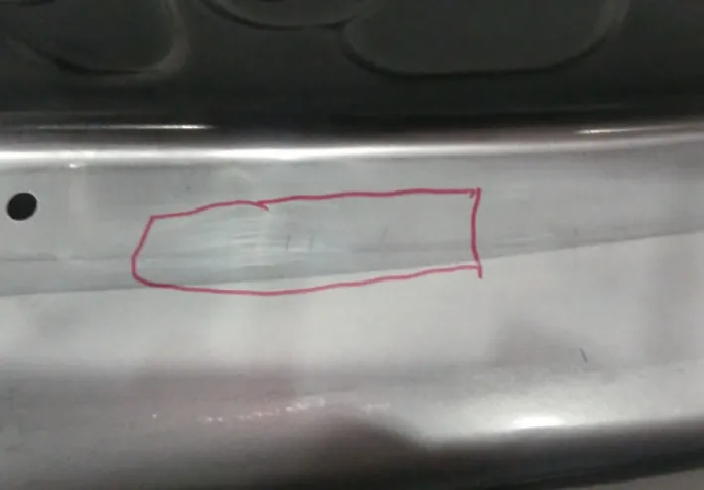
Parts in the drawing or forming process, the force state is very complex, there is no rule to follow, due to the thickness of the sheet material and the length and width of the two directions compared to a lot smaller, so in the state of tensile and compressive stresses in the direction of the thickness of the state is very easy to destabilize, resulting in wrinkles, such as shown in Figure 3. Wrinkling can be divided into compressive stress wrinkling, uneven tensile stress wrinkling and shear stress wrinkling. Compressive stress wrinkling is characterized by the presentation of perpendicular to the direction of the recessed mold opening, generally appearing in the corner of the recessed mold opening, due to shrinkage and deformation, the crystal lattice in the sheet in the direction of parallel to the recessed mold corner of the compressive stress, the compressive stress exceeds the limit of the sheet to withstand, triggered by destabilization of wrinkles. Uneven tensile stress wrinkling generally occurs in the gentle region of the outer plate, due to the tensile stress, there will be no large folds, the main form of slow pit or ripple. Shear stress wrinkling is characterized by wrinkled area by the tensile force is not uniform, the adjacent metal lattice flow rate is not consistent, resulting in dislocation of instability, under the action of the shear stress caused by the wrinkling.
Production instability measures
In order to ensure production stability, mold trial production qualified and the production process, mold surface wear, the original process balance conditions are broken, production instability, are to be mold surface treatment, so that the mold to achieve a new stable state. Surface treatment has the following measures.
Concave mold corner profiling treatment
In the process of stamping production, the mold should be cleaned and maintained regularly to remove the zinc skin and oil on the surface of the mold, and at the same time check the roughness of the rounded corners of the concave mold. If the roughness is found to deteriorate, the need for concave mold rounded corners for profiling, profiling the minimum need to choose 600 ~ 800 mesh sandpaper, inside the pad on the rectangular grinding block, coated with abrasive paste in the rounded corners, along the direction of the material to be grinded until the roughness of the requirements.
Concave mold corner welding treatment
In the production of more serious local hair pulling or wrinkles, cracking phenomenon, excluding equipment and technology problems, generally for the wear and tear of stretching fillet hardness reduced to below 40HRC, or for stretching fillet cracks, broken. The solution is to have problems with the parts of the patch welding treatment, (1) patch welding before the broken parts of the removal, with an angle grinder to beat off the depth of 20mm, 10mm wide bevel, while meeting the edge of the bevel to exceed the fillet tangent point 5mm or more. (2) the choice of welding rod material, filler welding is generally two layers, inside the filler layer, outside the working layer, filler layer of welding rod selection and mold body mechanical properties are basically the same, especially the hardness and impact toughness, the material can be different from the body. The working layer welding rod should be good intermelt with the mold body, the combination must be firm, the combination to avoid cracks and bite phenomenon, after welding, the hardness should reach the hardness level of the mold body after quenching, more than 50HRC. Our stretching concave mold body material is ductile cast iron, grade GGG70L, filler layer electrode selection of the East China Sea's TC-3F, the working layer selection of Nichia's NH-100R, the use of good results. (3) Welding process speed should be uniform, intermittent welding, while the welding process should be tapped with a hammer to remove weld porosity and internal stress, to avoid cracks due to large temperature differences in the welding material or internal stress. (4) CNC machining after the completion of welding, leaving a 0.1mm margin, the remaining by artificial fine research, need to ensure that the repair parts and prototype surface articulation smooth, no undulation, after repairing the fine profiling, to ensure that the smoothness of the mold and roughness, and maximize the consistency with the original state.
Chrome plating
Electroplating is the process of plating a thin layer of metal or alloy on the surface of certain metals to prevent oxidation of the metal and improve the surface hardness and roughness of the surface, generally with the plated base metal as the cathode and the plated metal as the anode, through electrolysis, so that the cations of the metal in the solution are deposited on the surface of the substrate to form the plated layer of a surface processing method. Stamping professional plating, generally refers to hard chrome plating, mainly to improve the die surface hardness, wear resistance and reduce surface roughness. Electrolyte for the chromic acid solution, the surface of the substrate is plated with a thick layer of chromium plating, which is generally in the thickness of 10 ~ 20μm.
PPD treatment
PPD refers to pulsed plasma nitriding, is a lifelong anti-wear treatment technology for automotive coverings stamping die instead of plating, in a low vacuum (less than 2000Pa) environment, with the furnace body as the anode, to be treated as the cathode of the metal product, energized between the two produce up to a few hundred volts, so that nitrogen and other gas molecules are separated into nitrogen ions, hydrogen ions and electrons. Nitrogen ions begin to react with the matrix ions on the mold surface to form a hardened nitriding area. After nitriding the mold surface to form a layer of extremely hard alloy nitride (Fe4N, Fe2N), nitriding layer hardness can generally reach 50 ~ 60HRC, has a high surface hardness and wear-resistant layer, and applies to most of the automotive molds used in cast iron, cast steel materials.
PPD treatment has many advantages: (1) The surface can be treated with 800# and above oil stone. (2) The damaged surface can be welded. (3) The surface can be heat-treated at high temperature after replacing the welding. The shape of the surface will not change after heat treatment. (4) The molds after PPD treatment are generally guaranteed for 500,000 strokes. (5) Re-treatment is carried out after PPD treatment, and no other process treatment is required. (6) It does not pollute the environment. PPD treatment of the mold body to meet the following requirements: (1) first need to deal with parts cleaned up, remove the block, screws, guide slide plate and other accessories. (2) Ensure the quality of welding, there is no false welding, welding porosity, welding cracks. (3) In the PPD before the other coating treatment needs to be returned. (4) Surface roughness Ra0.2 ~ 0.4μm in the rounded part of the mold, Ra0.4 ~ 0.6μm in the flat area.
Surface treatment application
Beginning in September 2018, the production of normal production of 3 projects of 2 sets of front door inner plate, 1 set of rear door inner plate stretching mold frequent hair pulling phenomenon, occasionally interspersed with cracking and wrinkling. Seriously affect the production efficiency and product qualification rate, the organization of the production caused great trouble. Therefore, the factory set up a project to solve this problem. After a period of investigation and statistics, each batch has a different degree of downtime.