

Multi-point forming technology is a technology to realize rapid forming of different shapes of plate parts through computer control by replacing the traditional overall mold with a regular arrangement of basic body points.
The following is a detailed introduction of Multi-point molding technology:
First, the principle of technology and classification
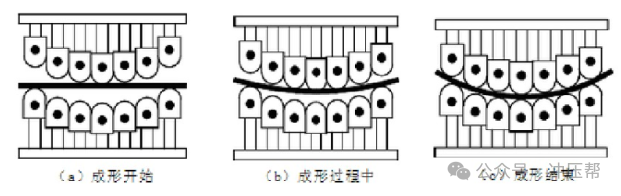
Multi-point molding technology uses a computer to control the position of the basic body to form a “flexible mold” with variable shape. It is mainly divided into four ways: multi-point mold forming, multi-point press forming, half-multi-point mold forming and half-multi-point press forming. Among them, multi-point mold forming and multi-point press forming are the most basic forming methods.
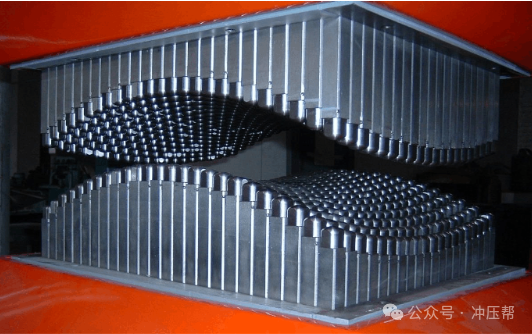
Second, the technical characteristics of moldless forming:
replace the traditional overall mold, save the mold design, manufacturing, debugging manpower, material and financial resources required to significantly shorten the product production cycle and reduce production costs. Optimization of deformation path: real-time control of the deformation surface through the basic body adjustment, changing the deformation path and force state of the plate at will, improving the material forming limit, and realizing the plastic deformation of difficult-to-machine materials. High precision and quality: The formed products are of high precision and good quality, and the production efficiency can be significantly improved. Reboundless forming: Repeated forming technology can be used to eliminate the residual stress inside the material, realize small or reboundless forming, and ensure the forming accuracy of the workpiece. Easy to realize automation: the whole process is all computer-aided, including surface modeling, process calculation, press control, workpiece testing, etc., with high efficiency and low labor intensity.
Third, the advantages and disadvantages of multi-point molding technology
Advantages of multi-point molding technology.
Improve production efficiency: multi-point molding process can be carried out at the same time for multiple points of forming, greatly improving production efficiency. For example, in the automobile manufacturing process, the traditional body welding process requires multiple positioning to complete the welding, while the multi-point forming process can be carried out at the same time to connect a number of welded joints, thereby significantly improving the welding speed. Improved product quality: By applying multiple forces at different points simultaneously, the multipoint forming process distributes stresses more evenly and reduces distortion and defects in the workpiece. This is particularly important in the aerospace industry to ensure the stability and safety of thin-walled structural components in high-temperature and high-pressure environments. Enabling the machining of complex shapes: Because forces can be applied simultaneously at multiple points, the multipoint forming process enables the machining of materials with complex shapes, such as curved and twisted shapes. This is important in the manufacture of high-precision molds and tooling. Saving mold cost: Multi-point forming technology realizes moldless forming, which does not need to configure molds, thus saving the cost of mold design, manufacturing and debugging. This is especially advantageous for the production of single-piece, small-lot parts, which can fully realize the specification of automatic forming and improve the quality of forming.
Disadvantages of multi-point forming technology.
Equipment and process complexity: multi-point forming process requires a sophisticated control system to simultaneously control the processing of multiple points, which puts forward higher requirements for the manufacture and maintenance of equipment. Limited scope of application: For some larger sized workpieces, the multi-point forming process may not be applicable because it requires a lot of force to process multiple points simultaneously. Difficulty in controlling machining accuracy: moldless multi-point forming is affected by the nature of the material and the thickness of the plate, etc., and the machining accuracy is difficult to control, and it is prone to problems such as dimensional deviation or irregular shape.
Fourth,development and Innovation
Multi-point forming technology was created by Dr. Li Mingzhe, a professor at Jilin University, and is regarded as a major innovation in the production method of three-dimensional curved surface forming of plate-like parts. The technology has not only been widely used in China, but has also been exported to South Korea and other countries for the manufacture of ship hull outer plate parts and so on. In addition, the technology has been supported by a number of national and provincial scientific research projects and international cooperation projects, showing its strong vitality and broad application prospects.
Fifth, specific application scenarios of multi-point molding technology
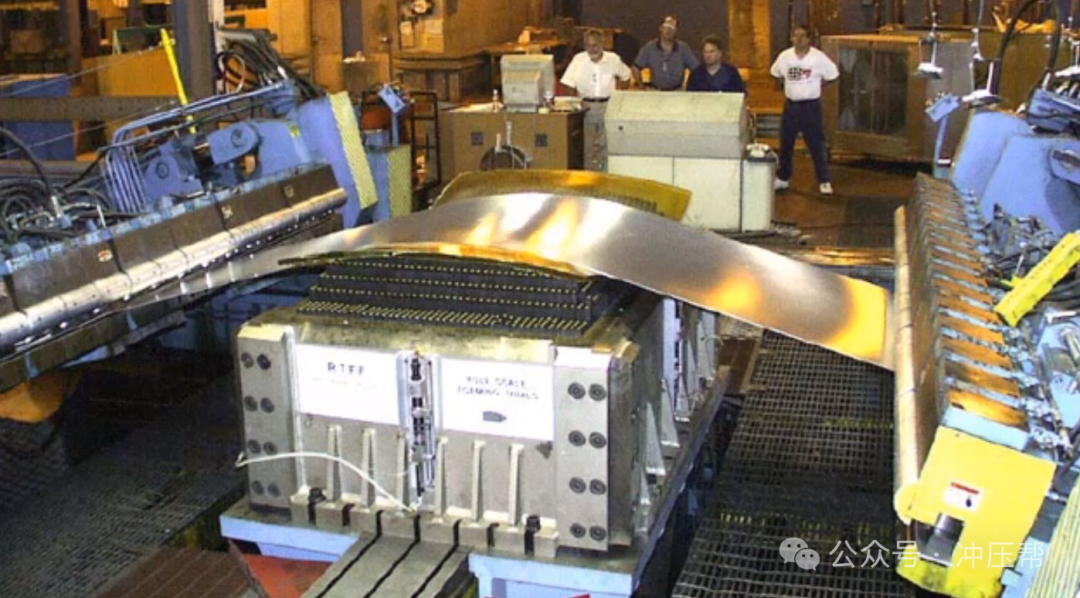
Plate forming: multi-point forming technology through real-time control of the movement of the basic body, the formation of instantaneous forming surface changes at any time, to achieve the optimal deformation path of the plate forming, eliminating molding defects, and improve the forming ability of the plate. Moldless forming: Moldless multi-point forming technology combines computer technology to realize moldless, rapid and low-cost production by controlling the deformation surface in real time through the regular arrangement of basic bodies. This technology is suitable for the production of large three-dimensional curved plate products of different shapes and sizes. Flexible Stretch Forming: Based on the traditional stretch forming, the new flexible forming technology is designed and developed by utilizing the hydraulic system and material work-hardening characteristics, which can improve the yield rate of workpieces and material utilization rate. Continuous roll pressure multi-point forming: based on the principle of flexible roll and multi-point shaping, the bending degree of the flexible roll is obtained by adjusting the relative height of the shaping unit to realize the continuous feeding and plastic deformation of the sheet.
In summary, multi-point forming technology with its unique advantages in the manufacturing industry is playing an increasingly important role in improving production efficiency, reducing production costs and promoting the innovative development of the manufacturing industry has made an important contribution.