

In recent years, with the rapid development of industrial technology, automotive stamping production toward high-speed, intelligent direction of rapid progress, the mold manufacturers and host plants continue to apply a variety of innovative technologies and intelligent means to the mold installed on the eyes and brain, which also provides a variety of possibilities for a lot of previously unsolvable traditional industry challenges, such as guiding gap monitoring.
Stamping forming is microscopic forming, stamping forming process of the die guiding parts of the abnormal changes in the gap on the quality of the stamped parts have a significant impact on the quality of the stamped parts, such as: guiding wear, tapered balance block wear.
Since most of the guiding parts are hidden inside the molds, they cannot be inspected visually, etc., and can only be measured when the molds are dismantled and inspected, which on one hand is a big workload, and on the other hand, the timeliness cannot be guaranteed, which leads to the problem of not being able to identify the true cause of the problem quickly and efficiently, and it is a pain point problem.
In recent years, we have been committed to finding a simple and efficient measurement or monitoring method to achieve the control of key guiding accuracy and ensure the controllable state of the mold. In this context, through extensive analysis and practice, we have developed relative monitoring solutions based on different guiding modes and the application of intelligent sensing means.
For exposed guides, we design an anti-wear marking mechanism, which identifies wear and tear by marking the guide with a fixed depth mark, which can be identified visually through daily downtime inspections and overhauls. This method is simple, effective and low cost, only according to different guide gap requirements, the application of marking mechanism, in the four corners of the guide plate on the corresponding depth of the logo mark can be (we generally actual 0.05mm and 0.1mm two specifications of the mark). By observing the wear of the marks, on the one hand, we can determine the approximate amount of wear, and on the other hand, we can also determine whether the guide plate is subject to bias load wear, which is also of guiding significance for wear analysis.
For the embedded guide, we creatively proposed to utilize the on-off circuit principle and adopt the contact alarm method to monitor the fixed wear of the guide. Based on the above idea, we have developed a set of special contact sensor TSN, which can be used to set the amount of wear, and when the guide plate wear reaches the set amount of wear, it will trigger the mold alarm, prompting the technician to restore the amount of wear and achieve preventive maintenance.
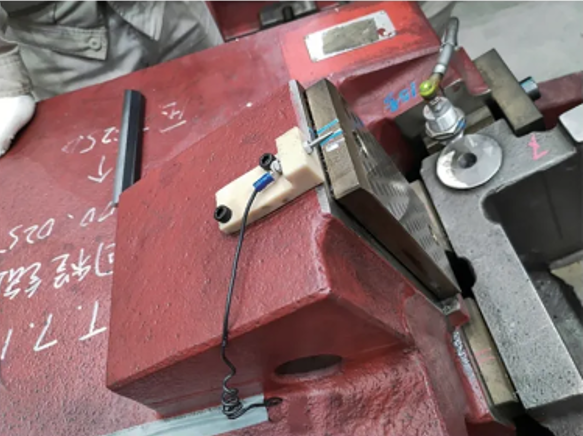
The application of the contact sensor TSN is a perfect solution to monitor the change of the embedded guide gap, which is of positive significance to improve the stability of the mold.
In the use of the sensor, we found that the above structure can not only be used in embedded guide gap monitoring, there are many other application scenarios, which can solve many problems that could not be effectively solved in the past.
Application Scenario 1: Height Detection of Conical Balancing Block
Conical balancing blocks are generally used in the repunching process to balance the gap between the upper and lower dies on the one hand, and to position the upper and lower dies on the other. During daily use, due to frequent high-pressure and high-speed impacts, after a period of time, the conical balance block will be extruded and deformed, and the closing height of the upper and lower blocks will be reduced, resulting in quality defects such as indentation of the parts. The traditional inspection method is to judge the wear and tear by visual inspection, hand touch or simple measurement, which is poor in timeliness and inaccurate in measurement results.
The contact sensor structure is installed on the mounting surface of the conical balance block, and dynamic monitoring is carried out by presetting the wear height. When the closing height of the upper and lower blocks is lower than the set value, the sensor alarms, prompting the mechanic to adjust the block by shims or replace it with a new one for advance pre-maintenance and prevention of quality fluctuations.
Application Scenario 2: Monitoring of drawing parts receiving line
Drawing receiving line (contour line) is a key factor affecting the quality of stamped parts. Through a large number of cases, it is verified that controlling the receiving line with reasonable changes can realize the stable production of stamped parts. Currently, there are two kinds of means to monitor the drawing rewinding line: one is the intelligent identification built by applying the visual recognition technology, which is still in its infancy, with insufficient accuracy and high cost; the other is to rely on human manual measurement for monitoring, with poor timeliness.
The development and application of contact sensor TSN can solve this problem more perfectly. By placing TSN in the trimming process and setting the monitoring range of the take-up line, when the take-up line elongation exceeds the set range, contact occurs with the sensor, triggering an alarm and prompting the technician to adjust the pressure to avoid quality defects.
Application Scenario 3: Screw Status Monitoring
Due to irrational design or unbalanced force, the screws on some parts of the mold are often loose or broken, which is difficult to identify in advance. Once this happens, it will lead to the damage of the mold surface in the light case, and in the serious case, it will lead to the accident of the mold. Needle then this situation, the conventional method is to strengthen the daily inspection and check, once found loose or broken signs, tighten in a timely manner, but from past experience, this practice is less timely, it is difficult to avoid problems.
Contact sensors are also effective in solving such problems. By prearranging the TSN sensor on the mold, the sensor stylus is in contact with the screw, and when the screw loosens or breaks, the sensor alarms and triggers equipment shutdown, avoiding mold accidents.
Through the innovative application of contact sensor TSN structure, can achieve 0.1mm precision control, for mold functional parts detection, has practical application significance, and simple structure, easy to use, low cost, broad application prospects, for the development of intelligent mold is also a useful supplement.