

First: Concept
Deep-drawing: the plate material pressed into a hollow piece (wall thickness is basically unchanged) deep-drawing process: is from the plane (flange) on the transfer of material to the cylinder (box) side walls, so the plane of the external dimensions of the larger changes in the deep-drawing coefficient: deep-drawing diameter and the embryo diameter of the ratio of “m” (embryo to the degree of deformation of the workpiece)
Deep drawing is an extremely common process in metal forming.
Second: the main factors affecting the rate of deep drawing coefficient
(1) the mechanical properties of the material (buckling strength ---- elastic deformation; tensile strength ---- plastic deformation; coefficient of elongation; section shrinkage)
2) The relative thickness of the material (T / D < 1 D is the diameter of the embryo)
(3) the number of deep drawing: due to the existence of cold hardening phenomenon, in addition to the intermediate use of annealing process, generally each time the m-value for the first increment (m1<m2<m3 visible m1 as far as possible to take the smallest value)
4) Deepening method: with or without the pressure plate on the m value of the shadow rate is a pressure plate m can be taken smaller; convex mold R is too small is more likely to produce dangerous cross-section rupture
5) convex and concave mold radius: concave mold R can reduce the friction of forming, but too large when the press area is reduced will cause wrinkles
6) Deep-drawing surface finish and lubrication conditions, clearance, etc. deep-drawing speed: deep-drawing speed is too fast, the flange material can not be converted to the side wall in time to rupture easily rupture flange-free cylindrical parts with or without the use of the size of the pressure edge circle m value
Third: the first deep-drawing coefficient of flanged cylindrical parts is affected by the following factors
(1) where d convex / d1: flange relative diameter should include trimming allowance
2) h1/d1 = relative height (narrow flange: d convex / d = 1.1 ~ 1.4)
3) r/d1=Relative fillet radius (wide flange: d convex/d>1.4)
4) t/D = relative thickness
For wide flange cylindrical parts generally require the first deep-drawing into the required flange diameter, at this time should try to use a smaller m1, both with the full deformation capacity, and then the next deep-drawing in the flange diameter to remain unchanged (the principle of flange invariance)
Fourth: deep-drawing process arrangement
(1) thinner material deep drawing depth than the diameter of the parts: to reduce the cylinder diameter to achieve an increase in the height of the method, the corner radius can be reduced step by step
(2) Thicker material depth of pull depth and diameter of similar parts: can be used to maintain the height of the same gradually reduce the barrel diameter in the process of reducing the radius of the fillet
(3) The flange is very large and the radius of the circle is very small: should be achieved through a number of shaping
(4) flange is too large: if necessary, should be adopted to expand the shape of the method to reflect the “flange is not changed” principle, so that the first deep-drawing the formation of the flange does not participate in the subsequent times of deep-drawing deformation, wide flange deep-drawing to reduce the first time into the concave mold material (i.e., the formation of the wall and the bottom of the material) should be more than the final deep-drawing to complete the actual material required for the completion of the material more than 3~10%.
Note: Take the upper limit when calculating the number of deep-drawing times by area, and take the lower limit vice versa. These excess materials will be in the subsequent deep-drawing faceted step back to the flange, caused by the flange thickening but can avoid the head cracking, localized thinning of the region can be corrected by shaping. Therefore, it is very important to strictly control the height of each deep drawing.
Five: box-shaped parts deep drawing
The corner part is equivalent to the deep drawing of the cartridge, and the straight wall part is equivalent to the bending deformation.
Six: deep drawing lubrication theory
1:Single-side lubrication in the deep-drawing process, there is friction between the material and the mold exists, this time there are five kinds of friction:
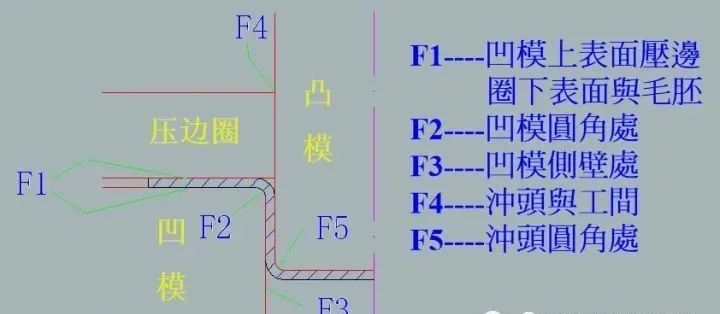
F1---- concave mold upper surface crimp, circle lower surface and the embryo
F2---- rounded corners of the concave mold
F3---- at the side wall of the concave mold
F4----punch and work room
F5---- at the rounded corner of the punch
A: Friction F1, 2, 3 against the direction of deep-drawing deformation, not only make the deep-drawing coefficient increase, the deep-drawing force increase and will wear and scratch the surface of the mold and the workplace, so it is harmful B: F4, 5 with the direction of deep-drawing molding and has the effect of preventing the material in the dangerous section of the thinning of the surface, and therefore is beneficial Based on this analysis, the deep-drawing operation should be lubricated on the side of the concave die, do not allow lubrication of the punch side in production. In practice, sometimes the surface of the die and crimp ring will be polished as much as possible and the punch surface will be roughened to carry out deep drawing.
C: single-sided lubrication is only suitable for the deep drawing of certain cylindrical parts but not for the deep drawing of the entire deep drawing process (e.g. shallow cylindrical parts, box-shaped parts and expansion deformation of curved surfaces of the main parts of the deep-drawing molding).
2: double-sided lubrication theory box-shaped parts deep drawn double-sided lubrication from the point of view of deformation, the deformation of the cylinder-shaped parts deep-drawing is uniform, the deformation zone is required to smooth deformation and minimize the plastic deformation of the transmission zone, in order to improve the forming limit, this time only a single-sided lubrication in order to meet the requirements of the deep-drawing of the box-shaped parts, due to the deformation zone there are uneven deformation characteristics, and therefore the use of double-sided lubrication conditions to play the transmission zone of the deformation potential to compensate for the deformation of the two parts of the deep-drawing of the box-shaped parts. Deformation potential to compensate for the unevenness of the two parts of the deformation zone, not only to improve the load-bearing capacity of the transmission zone, but also to promote the whole deformation zone smooth plastic deformation, so the box-shaped parts of the deep drawing molding limit will be improved to a certain extent.