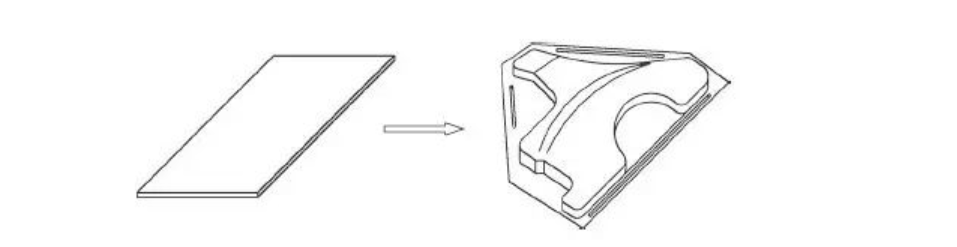
In Drawing, part or all of a flat plate is drawn into a concave cavity using a platen device and the punching force of a convex die to form a container with a bottom. Processing in which the sidewalls of the container are parallel to the drawing direction is pure drawing, while drawing of conical (or angular cone) shaped containers, hemispherical containers, and parabolic containers, etc., which also includes expanding processing.
Re-deepening process, that is, for a deep drawing process can not be completed deep drawing products, need to deepen the deep drawing process of the molding products for deepening again, in order to increase the depth of the molding container.
Reverse deep-drawing processing, the former process of deep-drawing workpiece for reverse deep-drawing, the inner side of the workpiece into the outer side, and make its outer diameter smaller processing.
Thinning deep-drawing process, with a convex die will have been shaped container extrusion than the outer diameter of the container slightly smaller than the concave model cavity, so that the container with the bottom of the outer diameter of the container becomes smaller, at the same time wall thickness thinning, not only to eliminate the deviation of the wall thickness, but also to make the surface of the container is smooth.
The deep drawing process using stamping equipment includes the following 16 major types:
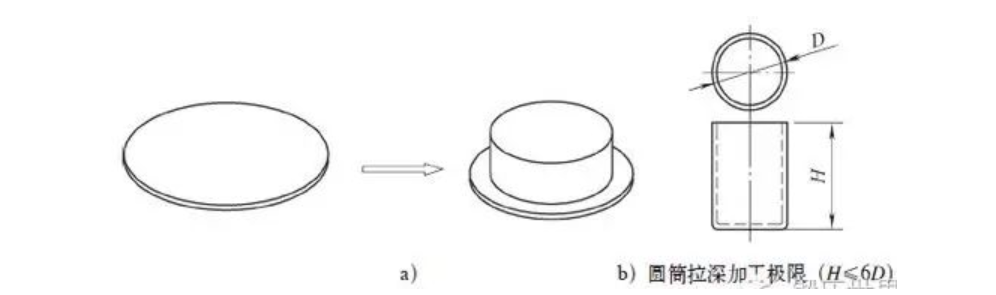
(1) Cylinder deep drawing (Round drawing)
As shown in Figure 1a, with a flange (flange) deep drawing of cylindrical products. The flange and the bottom of the plane shape, cylinder sidewalls for the axisymmetric, in the same circumference deformation uniformly distributed, the flange on the blank to produce deep drawing deformation.
The reference value for the limit of deep-drawing processing of cylinders is shown in Figure 1b.
(2) Ellipse deep drawing (Ellipse drawing)
As shown in Figure 2, the deformation of the blank on the flange for deep drawing deformation, but the amount of deformation and deformation ratio along the contour shape of the corresponding changes. The greater the curvature of the part, the greater the amount of plastic deformation of the blank; conversely, the smaller the curvature of the part, the smaller the plastic deformation of the blank.

(3) Rectangular deep drawing (Rectangular drawing)
As shown in Figure 3, a deep-drawing molding of low rectangular parts. When deep drawing, the resistance to deep drawing at the rounded corner of the flange deformation zone is greater than the resistance to deep drawing at the straight edge, and the degree of deformation at the rounded corner is greater than the degree of deformation at the straight edge.

(4) Hill drawing
As shown in Fig. 4, when the side wall of a stamped part is slanted, the side wall is suspended during the stamping process and is not attached to the mold until the end of forming. The deformation characteristics of different parts of the side wall during forming are not exactly the same.

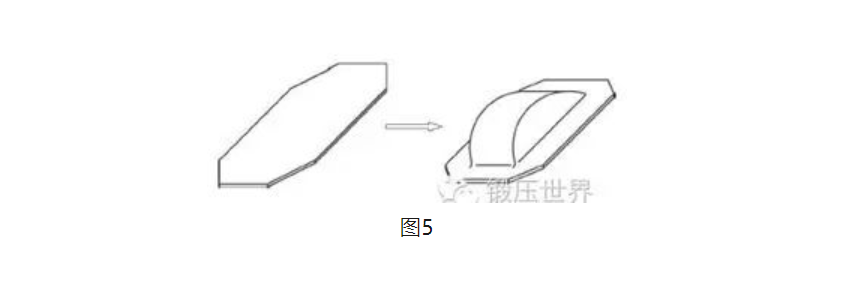
(5) Hill drawing
As shown in Figure 5, the deformation of the blank in the forming process of hill-shaped cover plate parts is not a simple deep-drawing deformation, but deep-drawing and expansion deformation at the same time the existence of composite molding. The deformation of the blank on the pressing surface is deep drawing deformation (radial tensile stress, tangential compressive stress), while the deformation of the blank inside the contour (especially in the center area) is expansion deformation (radial and tangential tensile stress).
(6) With flange hemisphere drawing
As shown in Figure 6, spherical parts deep-drawing, the blank and the convex mold of the spherical top of the local contact, the rest of the majority of the suspension in the free state of unconstrained. Therefore, the main process problem of deep drawing of such spherical parts is the severe thinning of the local contact part, or the instability of the curved surface part of the wrinkles.

(7) Flange drawing
As shown in Figure 7, the flange part of the deep-drawing product for shallow deep-drawing processing. The stress-strain situation is similar to compression flanging. Due to tangential compressive stress, easy to wrinkle, so the molding limit is mainly by the compression wrinkle limit.

(8) Edge drawing
As shown in Figure 8, the flange of the previous deep-drawing process for the flange of the product and then deep-drawing angular processing, such processing requires the material has good plasticity.

(9) Depth drawing (Deep drawing)
As shown in Figure 9, over the deep drawing processing limit of deep drawing products, need to be more than two times deep drawing can be completed. After the former work station depth direction deep drawing products, in the depth direction for deep drawing again. The wide flange deep-drawing part shown in Fig. 9 is deepened to the required flange diameter in the first deep-drawing, and the flange diameter remains unchanged in subsequent deep-drawings.

(10) Taper drawing
As shown in Figure 10, h / d> 0.8, α = 10 ° ~ 30 ° deep tapered parts, due to the depth of the larger, larger degree of deformation of the billet, only by the billet and the convex die contact with the local area of the transmission of the forming force, it is very easy to cause the billet localized excessive thinning and even rupture, the need for a number of transitions to gradually forming.
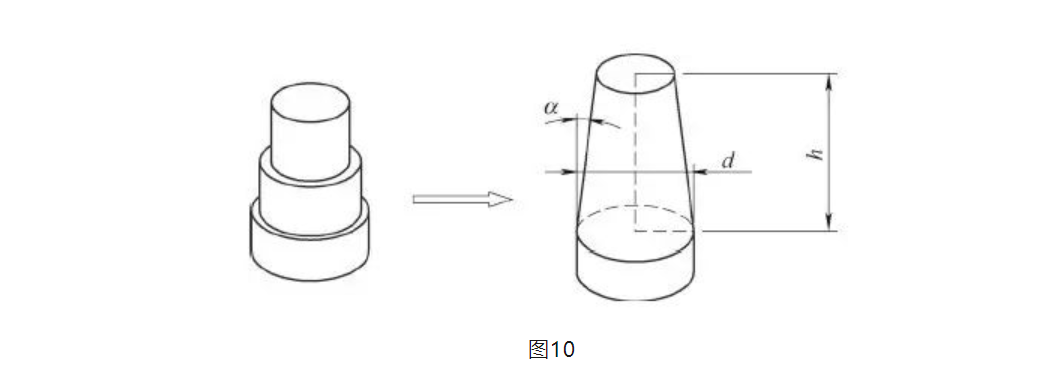
The step deepening method shown in Figure 10 is to first deepen the blank into a stepped transition part, whose step shape is tangent to the inner shape of the tapered part, and finally expand to form a cone. Ladder transition parts of the number of deepening, process, etc., and the deepening of the same step cylindrical parts.
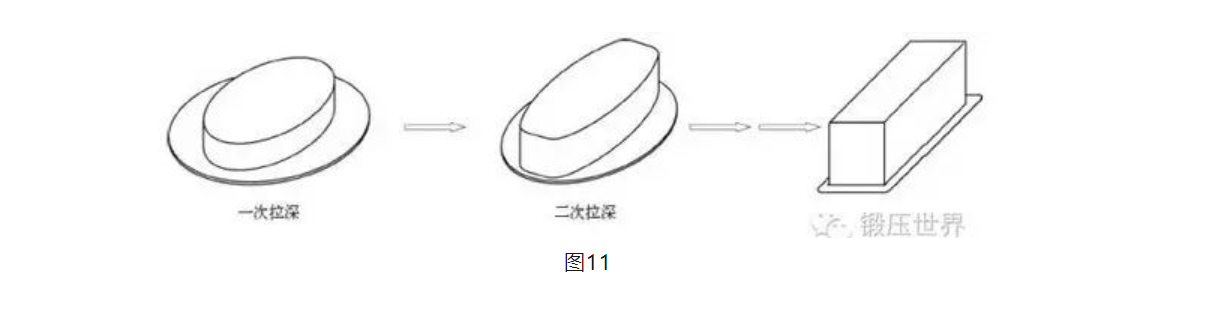
(11) rectangular deep drawing (Rectangular redrawing)
As shown in Figure 11, a number of deep-drawing molding of high rectangular parts, its deformation is not only different from the deep cylindrical parts of the deep-drawing, and the deformation of the low box-shaped parts are also very different. Figure 11 shows the multi-station automatic transfer press for high rectangular box processing, multiple deep-drawing process, the shape and size of the part along with the changes in the height of the deep-drawing.
(12) Surface forming
As shown in Fig. 12, surface deep-drawing forming is a stamping and forming method to make the outer flange part of a flat metal blank narrow and the inner flange part elongate, so that it becomes a non-straight-walled, non-flat-bottomed, curved hollow product.

(13) Step drawing
As shown in Fig. 13, the initial deep-drawing product on the left is deep-drawn again to form the step-shaped bottom on the right. The deeper part produces deformation at the beginning of deep drawing, and the shallower part produces deformation at the later stage of deep drawing. The sidewalls in the step-change portion tend to induce deformation from shear stress.

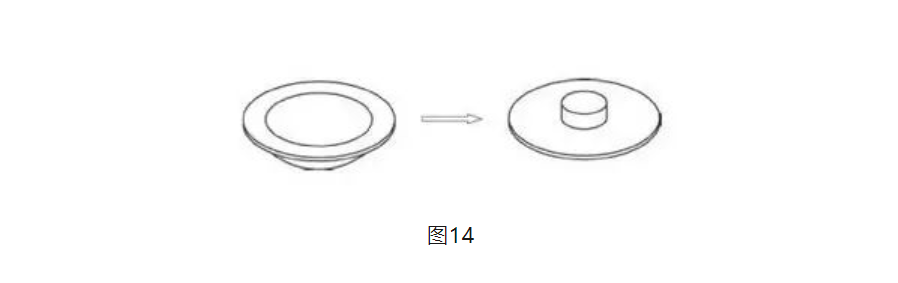
(14) Reverse drawing
As shown in Fig. 14, the workpiece deep-drawn in the previous process is deep-drawn in the reverse direction, which is a kind of deep-drawing. Reverse drawing method can increase the radial tensile stress, for the prevention of wrinkles can receive better results. It is also possible to increase the deepening coefficient of redrawing.
(15) Thinning Deep Drawing (Ironing)
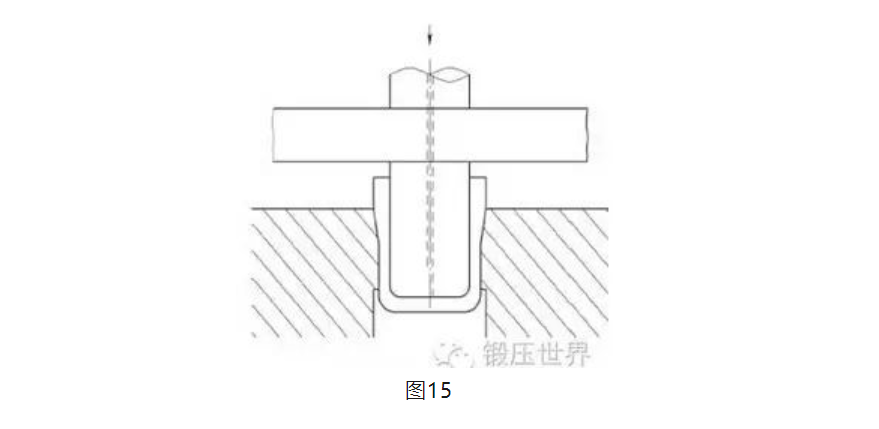
As shown in Figure 15, unlike ordinary deep drawing, Ironing is mainly used to change the thickness of the barrel wall of the deep drawing part during the deep drawing process. The gap between the convex and concave mold is smaller than the thickness of the blank, the blank straight wall part in the gap, in the larger uniform compressive stress, deep drawing process wall thickness thinning at the same time, eliminate the container wall thickness deviation, increase the smoothness of the surface of the container, to improve precision and strength.
(16)Panel drawing
As shown in Figure 16, the panel product is a sheet stamping part with complex surface shape. In the deep-drawing process, the blank deformation is complex, and its forming nature is no longer simple deep-drawing forming, but deep-drawing and expansion at the same time the existence of composite forming.